
SupergridEurope Responds to European Commission Energy Package on Network Charges and Electrification
Electrification Target Welcome, but Must Not Come at the Expense of 2040 Renewables and Efficiency Goals
Commenting on the European Commission’s Energy Package proposals, published in Brussels today, SupergridEurope lauded the Commission for its stated ambition for Europe to become “the first electro-continent” and for proposing that the EU establishes a 46% target for electrification. The Commission also deserves credit for seeking to reduce electricity tax rates to a level below that of fossil gas in all Member States.
SupergridEurope Executive Director, Christian Kjaer, said: “The level of European electrification has hardly increased in the past quarter of a century. Requiring Member States to terminate decades old habits of taxing electricity higher than fossil gas, combined with sensible new measures on network charges, more grid enhancing technologies and steering in the form of an electrification target, would finally start moving the dial on electrification.”
Among the initiatives published today by the European Commission are: A non-legislative Action Plan on Electrification; and a proposal for future-proofing electricity bills in the Union, changing the current EU rules on Network Tariffs.
Proposal future-proofing electricity bills in the Union, changing the current EU rules on Network Tariffs
Network charges represent about one quarter of the electricity bill for European households. The proposed regulation on network charges proposes that electricity taxes are reduced to a level below that of fossil gas in all Member States.
Christian Kjaer said: “For decades, tax policies throughout Europe have held back electrification, otherwise made possible by abundant domestic renewables, electric vehicle rollout and heat pumps, while providing preferential conditions for imported fossil fuels. It’s a bold move by the Commission to ask Member States to reduce electricity taxes below gas taxes, and it’s in the nations’ own long-term interest.”
The European Commission also introduces a requirement for regulatory authorities in Member States to monitor and provide incentives for non-wire, smart and digital solutions, such as innovative grid technologies. It is the first time EU regulation recognises the vast potential of grid enhancing technologies to free up capacity in the existing grids.
Kjaer continued: “Grid enhancing technologies are a no brainer. They are available today; they can be deployed in a few months; and they reduce overall system costs. Incentivising their scale-up and wide deployment would free up space in the existing grid to connect hundreds of gigawatts of renewables capacity to new electricity users, while new transmission lines are established.”
Also positive are the Commission’s proposed targets for rolling out smart metering systems, and the suggestion to allow Member States to “partially cover network costs through State funds” if they are non-discriminatory and benefit decarbonization and market integration. It lists as examples major grid updates, interconnectors and offshore grids.
On the negative side, SupergridEurope expresses concern that the Commission’s network charges proposal removes the existing link between network tariffs and interconnections. Current EU rules say that grid tariffs must facilitate more cross-border grid connections, “in particular to develop the required infrastructure to reach the minimum electricity interconnection target for 2030”. That provision has been dropped in the Commission's proposal on network charges.
Christian Kjaer said: “Removing electricity interconnectors from the new network tariff methodologies is an odd move for a Commission intent on facilitating an Energy Union based on greater electrification and the free movement of electricity over Europe's borders. It runs counter to the ambitions in its own Grids Package proposals.”
SupergridEurope also finds it unnecessary to provide energy-intensive businesses with a derogation from the energy efficiency and environmental protection requirements that are currently a condition for becoming subject to reduced or even zero energy tax.
Electrification Action Plan
The European Electrification Action Plan announces a target for 46% of the EU’s final energy consumption to be met by electricity, with the ambition for Europe to become the world’s first electro-continent. A proposal will be tabled later this year.
SupergridEurope supports the Commission’s intention to increase electricity’s share of final energy consumption in the EU from 23% today to 46% in 2040 but cautions that an EU electrification target is of very limited value in isolation. It must be complemented with binding 2040 targets for renewable energy and energy efficiency to serve its useful purpose. Moreover, the electrification target must be consistent with EU climate policies and ambitions to phase out fossil fuels.
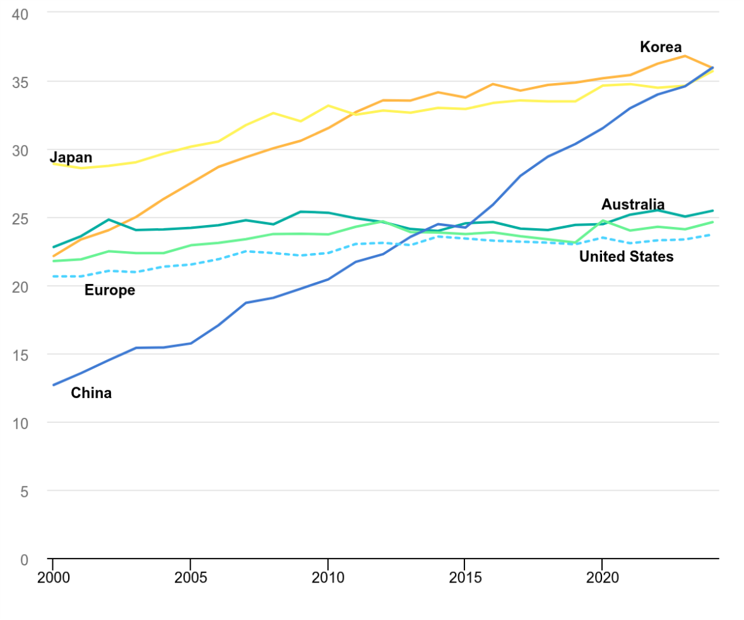
China has increased its electrification from 13% to 36 % since 2000, while Europe has gone from 21% to 23% in the past quarter of a century. China’s development is impressive but 50% of China’s electricity is from coal generation, adding 255 GW of new coal capacity over the past six years. Europe uses less than 10% coal, has not built a coal plant since 2019, and generates almost 50% of its electricity with renewables.
Christian Kjaer said: “An ambitious electrification target would provide a useful and important steer, but it is pointless if used in isolation and must not be used as a tool to undermine setting 2040 targets on renewable energy and efficiency. A post 2030 framework with binding targets for renewables and efficiency; a fossil fuel phase out; a grid master plan; and better designed interconnection targets for 2040, must all accompany an electrification target to serve a useful purpose”.
An electrification target does not address end-use efficiency or the carbon content of the electricity. Kjaer suggests that Europe’s ambition should be greater than becoming the world’s first electro-continent. Europe should strive to become the world’s first “RElectro-continent” - a continent powered by abundant, domestically produced renewable energy (RE). SupergridEurope also looks forward to the Commission's proposal, announced in today's Action Plan, to phase out fossil fuels later in the year.
The Commission’s Action Plan establishes several KPIs (Key Performance Indicators), including electricity/gas price ratios, 200 GW of storage, and a doubling of the heat pump installation rate.
Notes for editors:
Network charges represent about one quarter of the electricity bill for European households. Another quarter is taxes and half is the price of electricity. (European Commission)
In only two Member States is the electricity price less than twice as expensive as gas. (European Commission)
Since 2000, the EU has only marginally increased its rate of electrification – from 21% to 23%. In the same period, China increased its electrification share from 13% to 36%.
Read the European Commission's full press release and Electrification Action Plan.
Read the European Commission's Regulation future-proofing electricity bills in the Union (Network charges) here.
For further information, please contact:
Aoife Cronin, Communications Officer - aoifecronin@supergrideurope.eu | +353 85 283 7150